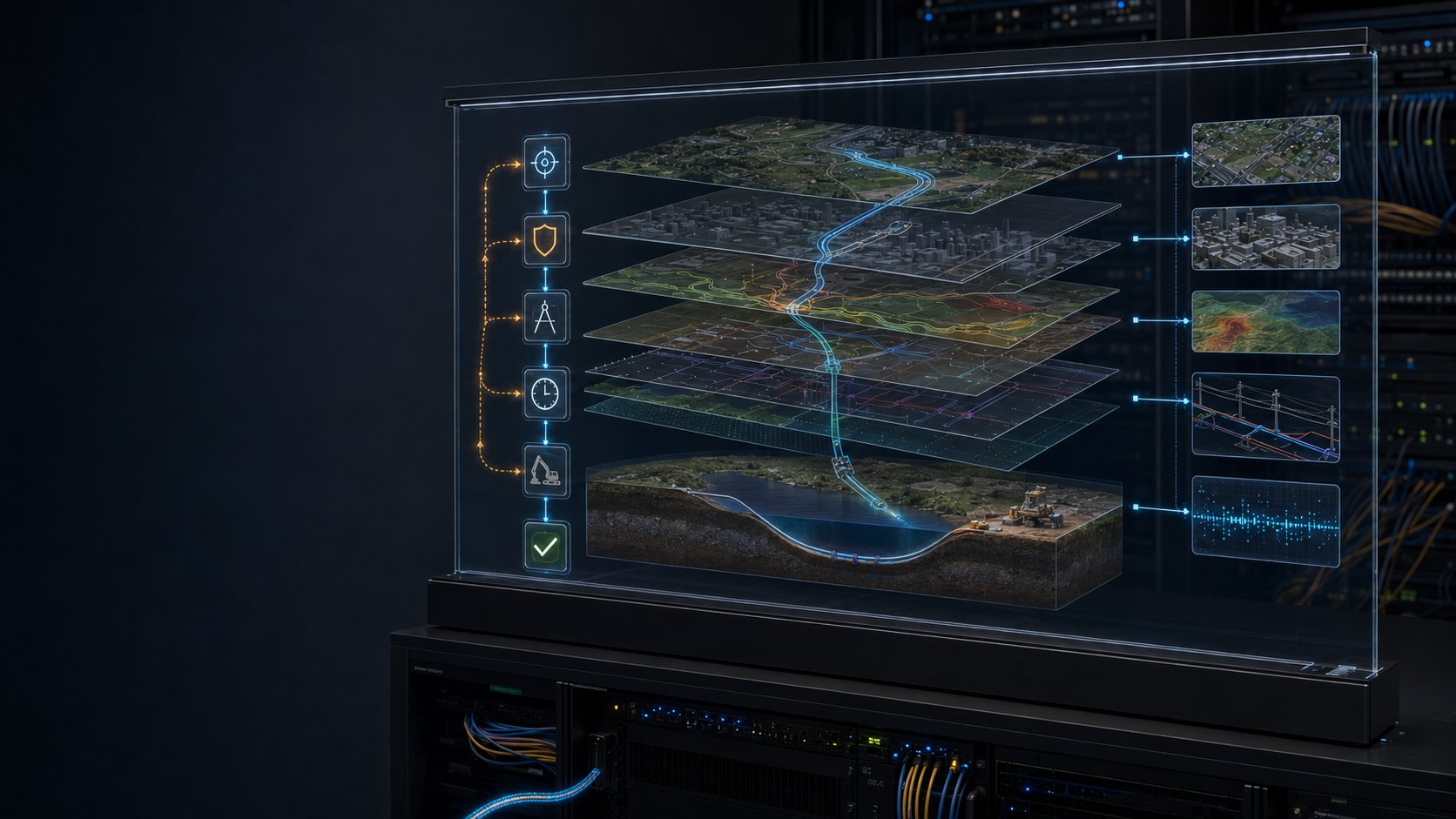
A placed initiative is a single feature. Its assessment, its plan and its programme are successive layers on that same feature — no ETL, no bridge, no interface between stages, and nothing lost along the way.
ORB reads the sources you already keep — authoritative maps, elevation, building and subsurface registers, and your own surveys — onto one datum, where they line up instead of drifting apart. A placed initiative is a single feature; its assessment, plan and programme are successive layers on that same feature, so there is no export between stages and nothing is lost. The full chain of states — how a feature moves, and can move back — is on the Platform page.
Authoritative open data and your own measurements land on one datum — read where they live, not copied into yet another silo.
Assessment, plan and programme are states on the same feature. No ETL between stages means nothing drifts and nothing is lost.
An organisation connects ORB directly and runs its own user management — a company-level integration rather than individual logins.
ORB reads a drawing and turns each line into an object with its geometry. The spatial engine then computes the crossings itself — two lines that intersect become a CROSSES relation, and the rules raise the conflict. No hand-drawn relations, no re-keying: the chain drawing → objects → crossings → conflicts runs on import.
One register of every external and internal source that feeds the platform — per source its type, endpoint, contract form and status (live / URL-ok / mock), and which parts of ORB use it. A test button runs a real fetch and shows the HTTP code and latency. Sources not yet connected are marked as such, honestly.
Active in one or more parts of ORB.
One source feeding three or more domains — read once, used many times.
No open API yet — flagged as needing a data agreement or a mock, not hidden.
Public sources throughout — PDOK, BGT, BAG, AHN, KLIC, BRO, RWS, ESA Copernicus — each testable, each tied to the standard it answers to.
Data & Integrations is one face of a single platform — see how it fits together, or talk to us about your own ORB.
